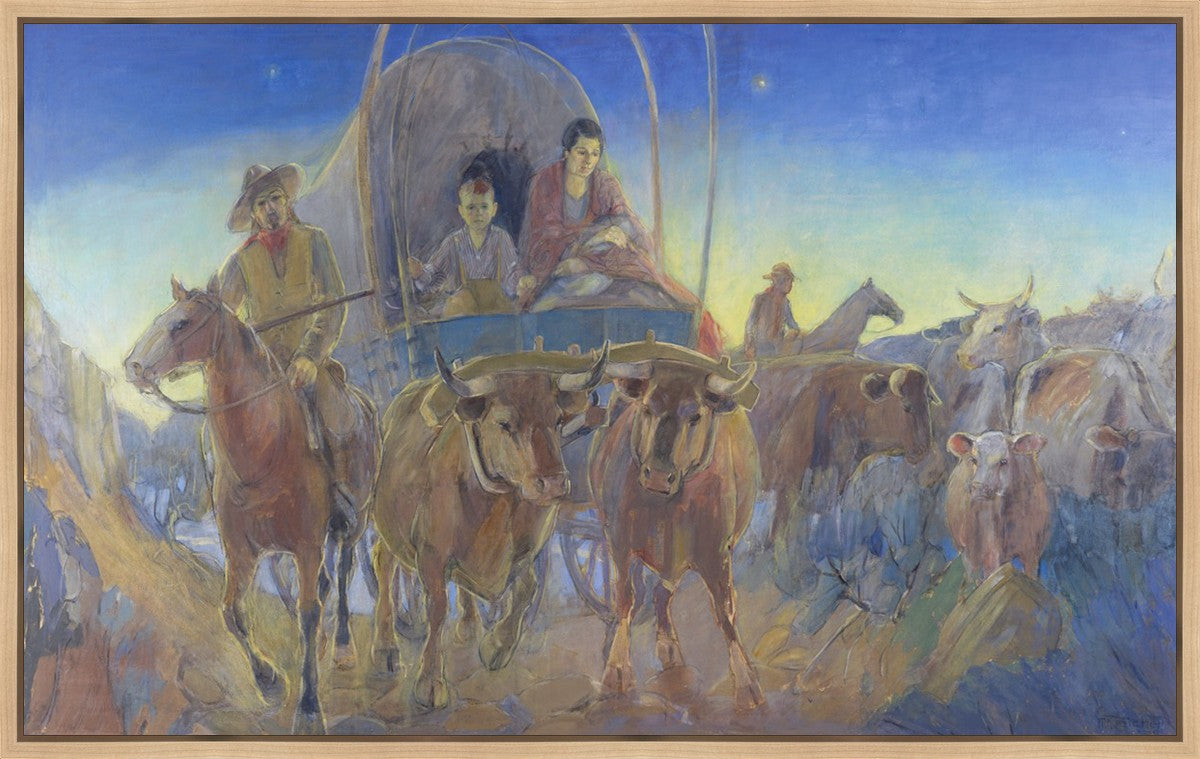
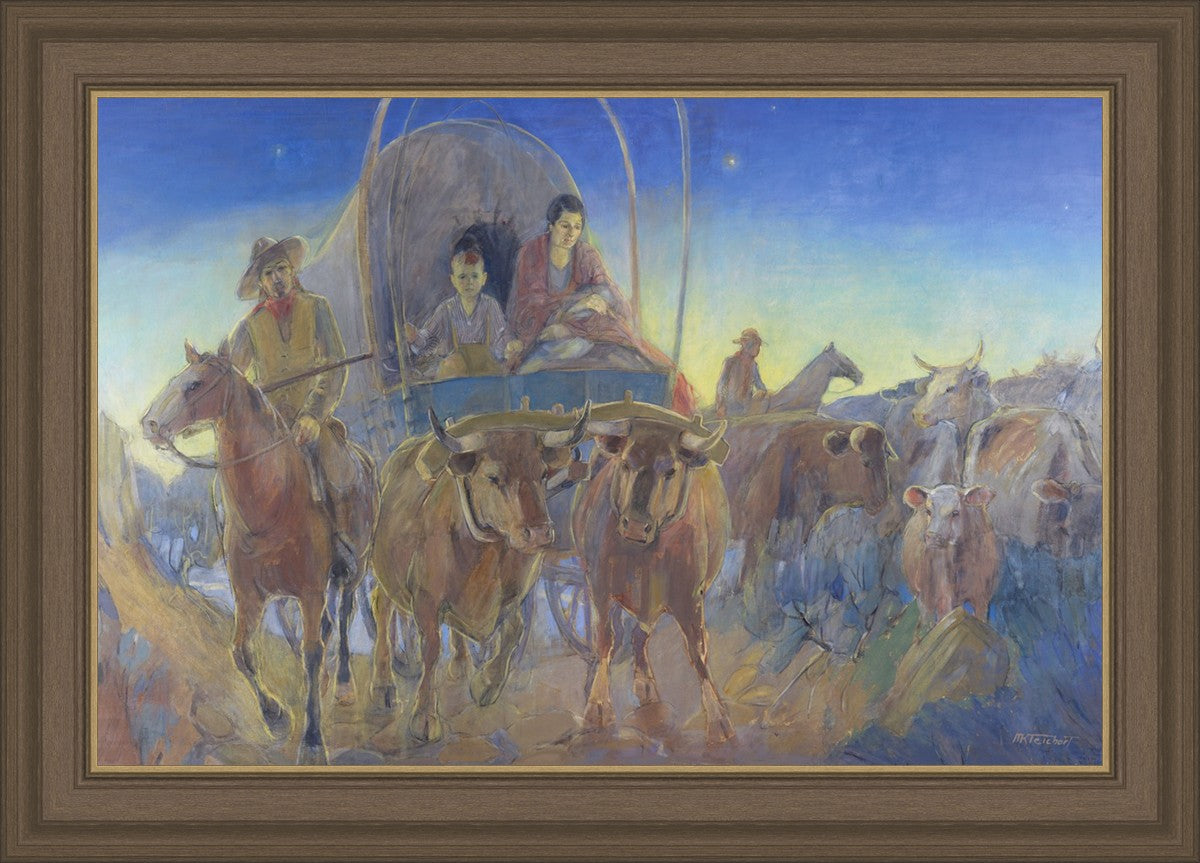
“In both Zion Ho and Miracle of the Gulls the female figures dominate the pictorial space, while the men appear as supporting figures in the background. Another 1930s pioneer mural by Teichert, purchased by the Cache Valley, Utah schools in 1935, portrays a woman as the central figure in a large covered-wagon scene. In Madonna of 1847 (fig. 41), the protective male figure holds a rifle, but walks at the side of the wagon, while the pioneer woman in a bright Paisley shawl assumes the form of a renaissance Madonna with child at the very center of the composition. Teichert''s heritage as a Mormon woman descended from pioneers countered the portrayal of pioneer women in the New Deal-era language of the comradely ideal. Mormon pioneer women, like Teichert''s grandmother Minerva Hickman, enjoyed a remarkable degree of independence, even when they numbered among the small group who were polygamous wives. While they valued their position as mothers and domestic workers, roles devalued by many women of today, they ran businesses, conducted schools, and were among the first women in the nation to benefit from the right to vote. 138 Unlike many pioneer women of America caricatured as "toothless hags," Mormon pioneer women prided themselves on their domestic achievements and personal appearance. 139 Had they painted themselves, Mormon women pioneers may well have fashioned idealized images similar to Teichert''s paintings, portraying members of their sex at their best-clean and tidy, in their finest clothing. Indeed this was the very image chosen for their photograph by two pioneer women sent with their husbands to open up mining in Utah. They appear in their finest clothing in the domestic task of delivering lunch buckets to their husbands in the mines. Mormon pioneer women were neither confined to the solitary life of many pioneer women on remote homesteads, nor limited to a fashionable life of polite accomplishments as were many of their contemporaries in the eastern United States. Even while crossing the plains, they enjoyed a life of community, 141 as depicted in another Teichert pioneer mural with women as the focus.” This piece is also sometimes referred to as “Madonna at Dawn”. Reproduced from the artist''s original artwork of Oil on Canvas, 72" x 132". Reference: Minerva Teichert: Pageants in Paint by Marian Wardle.
1888-1976
The works of western American artist, Minerva Teichert, have received increasingly popular and critical acclaim in recent years. Today, Teichert is beloved among the LDS community as a woman who successfully combined faith and family and left an extraordinary legacy of artistic production.
Minerva Kohlhepp was born in North Ogden, but grew up homestead farming in the vicinity of American Falls, Idaho. Her father encouraged her childhood sketching and she soon developed an “indomitable will to succeed and excel in the field of art.” She taught school to raise enough money to go to Chicago for her art studies.
If your order has a time sensitivity that requires expedited shipping, please Contact Us so that we can confirm our ability to meet your time requirements.
Many of the items on our site are custom made or built to order, especially framed items. A shipping time requested as "2-Day Priority Mail" refers to the shipment time once the item has shipped and does not include any assembly window. We pride ourselves on our efficient and timely system, but the complexity of an order will impact delivery. Orders to Hawaii may take 3-4 weeks to arrive via USPS. If you need your order sooner, please reach out to customerservice@ldsart.com.
For more information, please refer to the following policies:
Art Story
Art Story
“In both Zion Ho and Miracle of the Gulls the female figures dominate the pictorial space, while the men appear as supporting figures in the background. Another 1930s pioneer mural by Teichert, purchased by the Cache Valley, Utah schools in 1935, portrays a woman as the central figure in a large covered-wagon scene. In Madonna of 1847 (fig. 41), the protective male figure holds a rifle, but walks at the side of the wagon, while the pioneer woman in a bright Paisley shawl assumes the form of a renaissance Madonna with child at the very center of the composition. Teichert''s heritage as a Mormon woman descended from pioneers countered the portrayal of pioneer women in the New Deal-era language of the comradely ideal. Mormon pioneer women, like Teichert''s grandmother Minerva Hickman, enjoyed a remarkable degree of independence, even when they numbered among the small group who were polygamous wives. While they valued their position as mothers and domestic workers, roles devalued by many women of today, they ran businesses, conducted schools, and were among the first women in the nation to benefit from the right to vote. 138 Unlike many pioneer women of America caricatured as "toothless hags," Mormon pioneer women prided themselves on their domestic achievements and personal appearance. 139 Had they painted themselves, Mormon women pioneers may well have fashioned idealized images similar to Teichert''s paintings, portraying members of their sex at their best-clean and tidy, in their finest clothing. Indeed this was the very image chosen for their photograph by two pioneer women sent with their husbands to open up mining in Utah. They appear in their finest clothing in the domestic task of delivering lunch buckets to their husbands in the mines. Mormon pioneer women were neither confined to the solitary life of many pioneer women on remote homesteads, nor limited to a fashionable life of polite accomplishments as were many of their contemporaries in the eastern United States. Even while crossing the plains, they enjoyed a life of community, 141 as depicted in another Teichert pioneer mural with women as the focus.” This piece is also sometimes referred to as “Madonna at Dawn”. Reproduced from the artist''s original artwork of Oil on Canvas, 72" x 132". Reference: Minerva Teichert: Pageants in Paint by Marian Wardle.
About the Artist
About the Artist
1888-1976
The works of western American artist, Minerva Teichert, have received increasingly popular and critical acclaim in recent years. Today, Teichert is beloved among the LDS community as a woman who successfully combined faith and family and left an extraordinary legacy of artistic production.
Minerva Kohlhepp was born in North Ogden, but grew up homestead farming in the vicinity of American Falls, Idaho. Her father encouraged her childhood sketching and she soon developed an “indomitable will to succeed and excel in the field of art.” She taught school to raise enough money to go to Chicago for her art studies.
Shipping & Returns
Shipping & Returns
If your order has a time sensitivity that requires expedited shipping, please Contact Us so that we can confirm our ability to meet your time requirements.
Many of the items on our site are custom made or built to order, especially framed items. A shipping time requested as "2-Day Priority Mail" refers to the shipment time once the item has shipped and does not include any assembly window. We pride ourselves on our efficient and timely system, but the complexity of an order will impact delivery. Orders to Hawaii may take 3-4 weeks to arrive via USPS. If you need your order sooner, please reach out to customerservice@ldsart.com.
For more information, please refer to the following policies: